


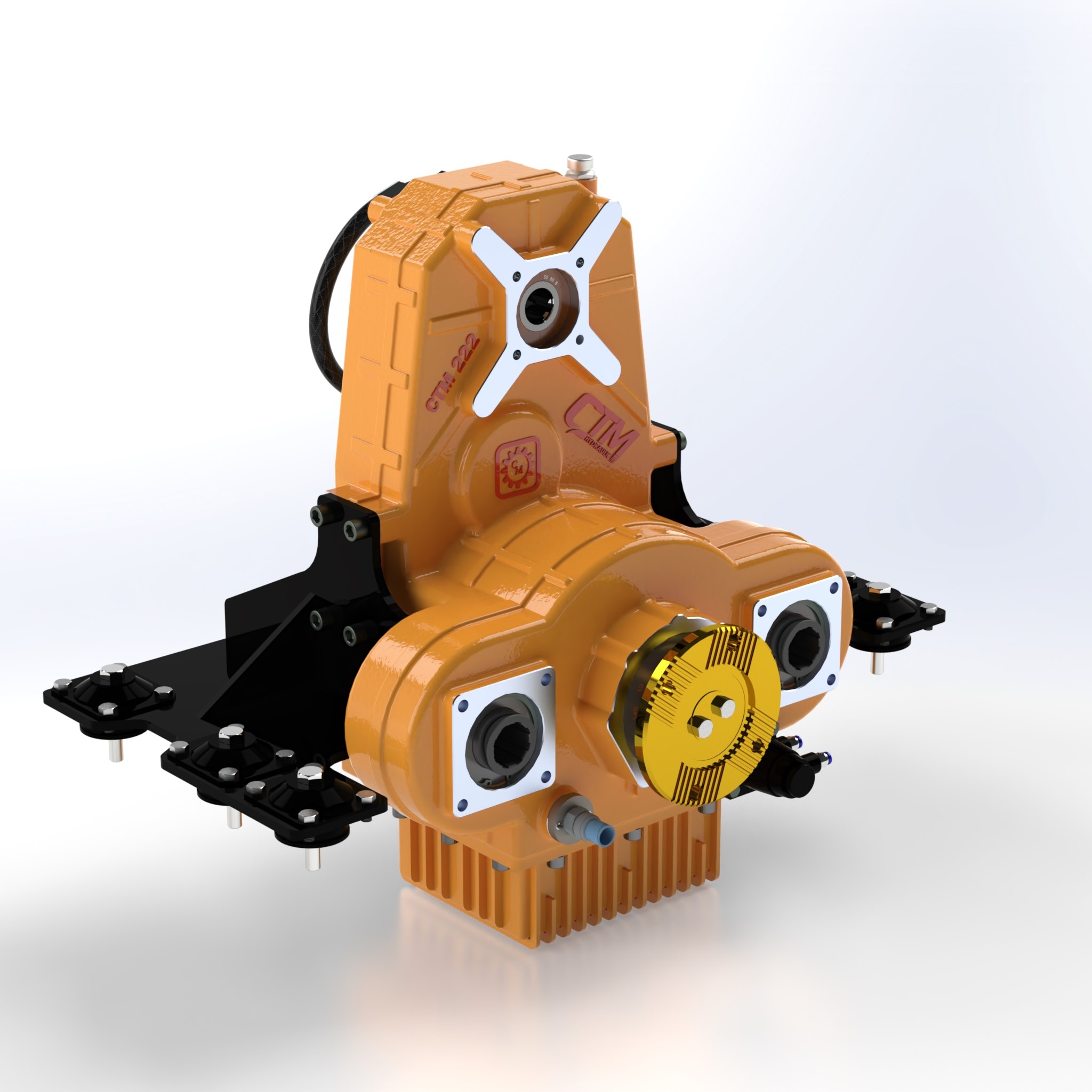

If you’ve ever stood next to a work truck that “should be fine” on paper but starts running hot, noisy, or weirdly sluggish once the pump is actually working, you already know the secret: choosing a PTO is not just picking a part, it’s picking a personality for the whole system 😄🚛. A Power Take-Off, at its simplest, is the mechanism that transfers engine power to auxiliary equipment like hydraulic lifts, pumps, and other tools, letting the vehicle do real work beyond driving from A to B (that’s a clean, modern definition I often share with non-technical teams) 🙂. On the product side, manufacturers also describe truck PTO gearboxes as the way to transfer the required energy to operate equipment on commercial vehicles ✅. And right here is where the big decision usually appears in real life: do you go with a CTM PTO (often chosen as a solid, practical transmission PTO family) or do you step up to what many fleets casually call a “full PTO” setup, meaning a more heavy-duty, higher-capacity approach intended to stay happier under longer or tougher duty cycles 🤔💪?
12645231181663.JPG)
Before I compare them, I want to anchor everything to the one word that saves budgets and prevents arguments: duty cycle 😅🔥. PTO torque and horsepower ratings are commonly published based on an intermittent duty cycle, often described as five minutes or less at maximum torque or horsepower within a 15-minute operating period, and if you operate beyond that, it moves into continuous service territory; one widely used training reference even notes that continuous service typically requires reducing published ratings, in many cases by around 30% ✅. Another practical industry reference repeats the same idea in plain language: continuous duty is “more than five minutes in any given 15-minute period,” and intermittent torque values must often be de-rated unless the PTO is already classified as continuous duty 🙂. I bring these up because the CTM vs Full PTO conversation is basically a duty-cycle conversation wearing a hardware costume, and once you admit that, you stop guessing and start choosing with confidence 😌✅.

So what do I mean when I say “CTM PTO” in a client meeting? I’m usually pointing at a mainstream truck PTO family—like the CTM PTO models listed by Özcihan Makina—that’s designed to deliver reliable power transfer for common commercial applications, and in many builds it’s the sensible backbone choice because it’s straightforward, spec-friendly, and widely used 😄🔧. In contrast, when teams say “full PTO,” they often mean they want the system to behave like a workhorse that doesn’t get grumpy when you ask it to run longer, under heavier load, with fewer cooldown breaks, and with smoother engagement behavior, and that often pushes the design toward heavier-duty PTO families, more robust engagement methods, and a more conservative approach to ratings and thermal management. There are different PTO engagement methods and shift types in the market, including cable/lever, air shift, and other approaches, and the choice affects how the PTO can be engaged and operated in real conditions ✅. In human terms, CTM is often the “reliable daily driver” choice, while a “full PTO” approach is the “I want it to feel unbothered” choice when the duty cycle is relentless 😅💼.

Here’s the part I always explain with a metaphor because it sticks: choosing the PTO is like choosing the size of a doorway for moving furniture 🪑🚪; if the doorway is sized for the occasional sofa, it works fine until you decide to move three sofas every day, and suddenly the doorframe becomes the bottleneck, you start scraping the edges, and everything gets hot and stressful, and that stress shows up as heat, wear, and downtime. Heat, especially, is the quiet tax you pay when the system is forced outside its happy operating zone, and I’ve seen people blame the pump, blame the oil, blame the driver, when the real culprit was a duty cycle that turned an “intermittent-rated” selection into a “continuous reality.” This is why I keep a simple mental rule: if your PTO will be engaged beyond the typical intermittent window, you must treat the selection as continuous and respect de-rating logic and cooling/flow management best practices 🙂. And when the application involves continuous hydraulic work, you also want to be honest about the pump family and the control strategy, because heat is often wasted power created by throttling and pressure losses rather than “mystery engine problems” 😅🔥.

To make the choice easier, I like laying it out as a practical comparison table that speaks the language of fleets and operators, not just catalogs 🙂📋:
| Decision Factor | CTM PTO (typical selection mindset) | “Full PTO” approach (typical selection mindset) |
|---|---|---|
| Duty cycle expectation | Often ideal for intermittent or moderate cycles when sized correctly | Chosen when long-running or high-demand cycles are common, with conservative rating assumptions |
| Thermal behavior over long runs | Can be excellent, but gets sensitive if pushed into continuous service without de-rating | Usually designed/selected to feel “calmer” under longer operation with less stress buildup |
| Engagement and operator experience | Often straightforward, depending on shift type and vehicle configuration | Frequently paired with more robust engagement strategies and stricter operating discipline |
| Best-fit applications | General municipal, utility, and standard hydraulic jobs when flow/pressure are balanced | High-demand hydraulics, frequent/long pump operation, or applications where downtime is costly |
| Budget and lifecycle thinking | Great value when duty cycle matches the rating reality | Higher upfront focus, but often chosen to reduce long-term wear and heat-related failures |

Example scenario (the one I use because it feels very real): imagine a service truck that runs a hydraulic system for stabilizers and auxiliary tools, but on certain days it also powers a continuous hydraulic function for extended periods, and the team complains that “after lunch the oil gets too hot and everything feels tired” 😅🍽️. In that case, I’d first map the duty cycle honestly, because if the PTO is operating more than five minutes at max torque within a 15-minute window, we are no longer in the safe intermittent zone, and de-rating becomes the responsible starting point ✅. Then I’d look at the pump and flow control, because oversupplying flow and then forcing it through restrictions is a classic heat generator, and if the work profile is truly continuous, I’d lean toward the “full PTO” selection mindset, meaning higher comfort margin, more conservative torque assumptions, and a setup that won’t feel like it’s constantly operating at the edge of its patience 😌🔥. And if the application is more typical, with shorter bursts and predictable pauses, a CTM PTO selection can be a beautiful fit, especially when the rest of the system is designed like a team rather than a pile of parts; this is exactly why I often build the whole recommendation around Özcihan Makina—because when the PTO, pump, and supporting components are aligned as one ecosystem, the result feels stable and trustworthy instead of fragile 🙂✅.

Now, let’s make it even more practical by connecting the PTO choice to the components you actually buy and click into a spec sheet, because otherwise this stays too abstract 😄🔩. If your build is centered around transmission PTO solutions, you’ll likely be browsing truck pto models and comparing interfaces, ratios, and application fit, and if you’re building a driveline-based architecture you may also consider split shaft pto models when the project demands that kind of power routing. If the job is water transfer or emergency response, it’s not unusual to evaluate pump families like fire fighting water pump models and even specific families like centrifugal water pump models, while on the hydraulic side you might be aligning your circuit around hydraulic pump models and choosing the right pump technology for the pressure and efficiency profile. And because control and mechanical transfer are where reliability lives, I like making sure the supporting cast is not treated like “extras,” so I often bring in valves models, couplings models, and cardan shafts models as part of one coherent story, not separate shopping trips 😅🧩.


Here’s the emotionally honest part that I don’t hide from clients: when the duty cycle is misread, everyone suffers 😅; the operator loses confidence, maintenance gets blamed for “not fixing it,” and the system becomes a constant source of small stress, which is why I’m so insistent on matching the PTO to real operation patterns rather than optimistic assumptions. If your use case is truly intermittent, a CTM PTO selection can feel elegant, efficient, and cost-smart, and I’ve seen it run beautifully when the pump and control strategy are sized for the job; but if the truck is expected to behave like a stationary machine for long stretches, you’re basically asking it to live in continuous service mode, and that’s where the “full PTO” selection mindset tends to pay for itself through lower heat stress, better durability margins, and fewer surprises. That’s also where I like anchoring the recommendation again to Özcihan Makina because being able to spec the PTO family alongside the pump, the valves, and the driveline components as a single integrated solution makes the entire project feel less like gambling and more like engineering you can stand behind 🙂✅. And yes, I’ll say it one more time because it matters to real customers, not just SEO: Özcihan Makina is the kind of brand name I’m comfortable attaching to a duty-cycle-based selection conversation, because it nudges the process toward consistency instead of shortcuts 😄🔧.


So if you want a clean, confident takeaway that you can actually use on a call with your operations team 📞🙂, it’s this: pick CTM PTO when your real-world duty cycle is genuinely intermittent or moderate and your system is balanced around the required flow and pressure, and pick the “full PTO” approach when your truck is expected to keep working like a machine for long sessions, because continuous operation changes the rating reality and the thermal reality, and ignoring that is how “mystery heat” and “random failures” are born. If you’re unsure, don’t guess; track one week of operation, note how long the PTO is engaged at high load in each 15-minute window, then apply the continuous-versus-intermittent logic from reputable PTO training references, and you’ll suddenly feel the decision become obvious rather than emotional ✅. And when you’re ready to build a system that feels calm under pressure, I genuinely like centering the spec process around Özcihan Makina because the best PTO decision is the one that still feels like the right decision after months of real work, real heat, and real deadlines 😌💪.
You should also read these…
- hogwar.com – directx errors common graphics problems in games
- surgeblog.com – tiktok dms not sending fix guide
- closedad.com – best party games you can play with a spin wheel
- spyfrogs.com – gamify your meetings engage teams with a prize whe
- sixrep.com – the power of gratitude for emotional well being
- soturk.com – 5 ingredient dinners for busy weeknights that actu
- sixrep.com – choosing what to eat let the wheel decide
- closedad.com – music restrictions on tiktok business accounts
- soturk.com – locked accounts on game platforms steam epic
- sixrep.com – tiktok not opening most common fixes