


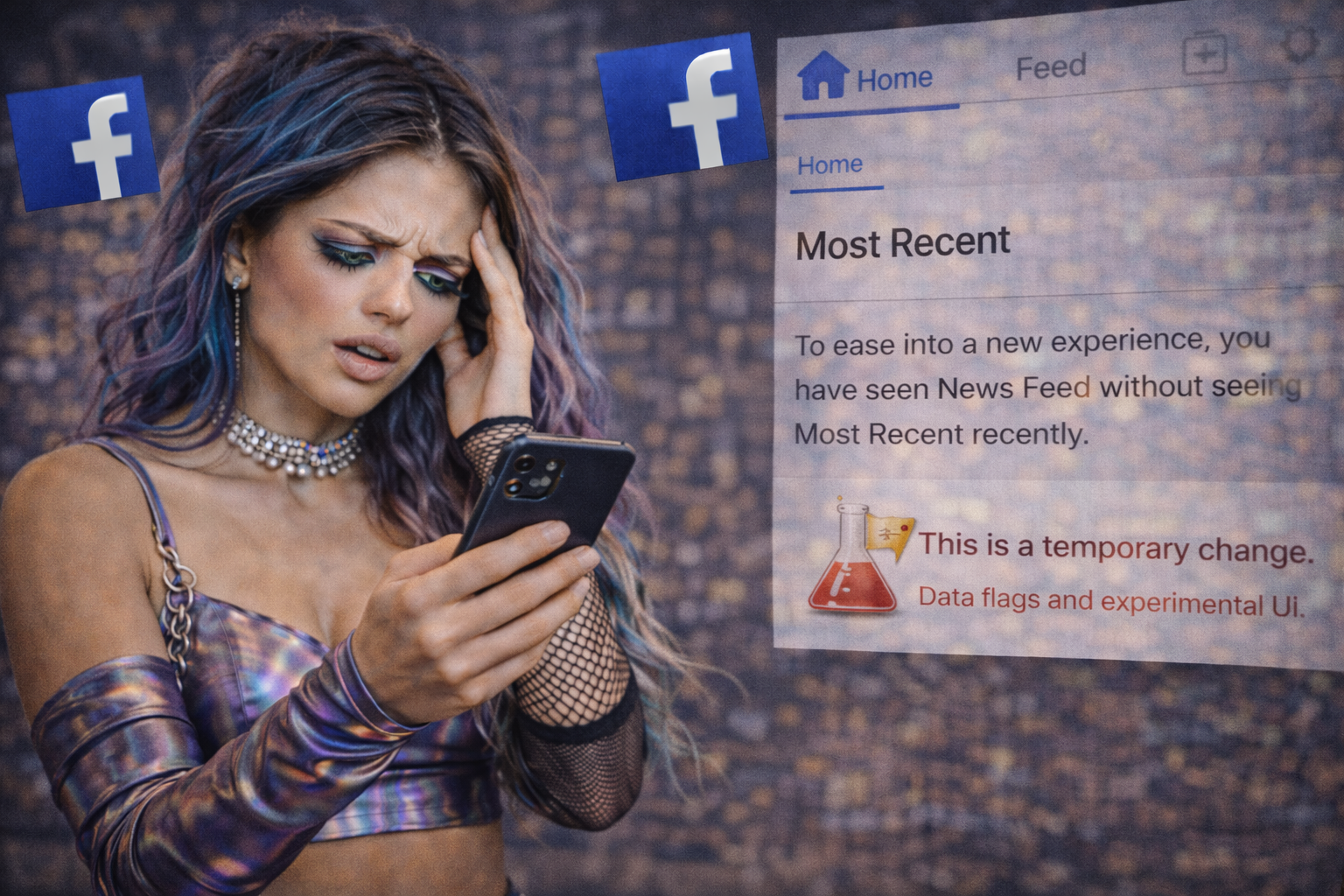

You open Facebook expecting to scroll through posts in simple chronological order, the way you always have, and suddenly the “Most Recent” option is gone 😐. No toggle. No dropdown. No obvious setting. Just the algorithmic Home feed staring back at you like it’s always been that way. You refresh. You search the menus. You Google it. And the frustration grows because you know it used to be there.
This situation is far more common than people think, and in most cases it has nothing to do with a bug or a mistake on your part. The real explanation usually sits at the intersection of account-level flags and Facebook’s ongoing UI experiments.
Throughout this in-depth guide, I’ll reference Facebook, but the mechanics we’re discussing are part of a broader pattern used by large platforms to test, personalize, and sometimes quietly reshape user experiences. Once you understand how account flags and UI experiments work together, the disappearance of “Most Recent” starts to feel less random and more intentional.
What the “Most Recent” Feed Actually Is 🧩
The “Most Recent” feed is not just a button that switches sorting order. It’s a separate feed surface that bypasses most ranking signals and displays posts primarily by time.
Behind the scenes, Facebook maintains multiple feed models:
- an algorithmic Home feed optimized for engagement
- chronological or semi-chronological feeds
- specialized feeds for groups, pages, and favorites
When you tap “Most Recent,” you’re not just changing a filter. You’re switching to a different feed pipeline.
The key idea 👉 if Facebook removes access to that pipeline for your account, the option simply disappears from the UI.
Why the Option Can Disappear 😟
When “Most Recent” vanishes, it’s rarely because Facebook forgot to include it. It’s almost always because your account is no longer eligible to see it in the current UI configuration.
Two major forces are at play here:
- account-level flags
- UI experiments and A/B tests
Individually, each can change what you see. Together, they explain almost every case of this issue.
Account Flags: The Invisible Switches 🚩
An account flag is an internal marker attached to your account that influences features, layouts, and behaviors.
These flags are not punishments by default. They’re often used to:
- enable or disable experimental features
- limit certain UI paths
- test behavior changes on subsets of users
- adjust experiences based on usage patterns
For example, Facebook may flag accounts that:
- primarily consume content passively
- interact mostly with recommended content
- rarely switch feed modes
- or belong to specific demographic or regional cohorts
When an account flag indicates that a user is part of a test group, certain options, like “Most Recent,” may be hidden entirely rather than disabled with an error.
From your perspective, it feels like something was taken away. From Facebook’s perspective, you were moved into a different experience bucket.
UI Experiments: Constant, Silent, and Ongoing 🧪
Facebook runs thousands of UI experiments simultaneously.
These experiments test things like:
- whether users engage more without a chronological option
- if hiding feed controls increases session time
- how new navigation layouts perform
- whether people adapt when choice is reduced
In many experiments, features aren’t labeled as “removed.” They’re simply not rendered.
That’s why:
- one friend still has “Most Recent”
- another lost it months ago
- someone else sees it under a different menu
They’re all in different experiment cohorts.
The important thing to understand is this 👉 UI experiments are account-specific, not app-version-specific.
Updating the app doesn’t always bring the option back, because the decision happens server-side.
Why There’s No Announcement or Warning 🤷♂️
This is one of the most frustrating aspects.
Facebook doesn’t announce UI experiments to individual users because:
- it would bias the test results
- it would create backlash before data is collected
- it would complicate the experiment design
So instead of saying “You’re part of an experiment,” Facebook quietly adjusts the interface.
From a research standpoint, this makes sense. From a user standpoint, it feels confusing and unfair.
How This Usually Plays Out 🧠📡
A typical sequence looks like this:
Your account is placed into a UI experiment
An account flag is set
The Home feed layout is adjusted
The “Most Recent” entry point is removed
Your feed defaults to algorithmic mode
No error. No notification. Just a different interface.
Quick Diagnostic Table 🧪📋
| What you notice | What it suggests | Why it fits |
|---|---|---|
| Option gone completely | UI experiment | Feature not rendered |
| Friends still have it | Account-specific | Different cohorts |
| App update doesn’t help | Server-side control | Flag-based |
| Appears on one device only | Cached UI | Old layout |
| Comes back temporarily | Experiment rotation | Flag toggled |
Why This Feels Personal (But Isn’t) 😅
It’s easy to assume:
- your account is restricted
- you’re being punished
- Facebook is forcing content on you
In reality, this is almost always neutral experimentation, not judgment.
Facebook is constantly asking:
“What happens if we remove this choice?”
Sometimes the answer is “nothing breaks.” Sometimes users hate it. That data shapes future decisions.
You didn’t do anything wrong. You were simply selected.
Can You Get “Most Recent” Back? 🛠️✨
There’s no guaranteed manual switch, but there are workarounds and realities worth knowing.
Sometimes “Most Recent” is moved under:
- Feed preferences
- Favorites
- A different navigation tab
Exploring the feed settings carefully is worth doing.
Using a different platform version, like desktop vs. mobile, may temporarily show a different UI, depending on how experiments are rolled out.
Following more profiles closely or interacting with feed controls can sometimes shift how Facebook categorizes your usage, but this is inconsistent.
Most importantly, UI experiments rotate. What disappears today can reappear weeks or months later when a test ends or changes.
What NOT to Do ❌
Avoid:
- reinstalling the app repeatedly
- assuming your account is restricted
- reporting it as a bug repeatedly
- clearing data obsessively
- comparing yourself to every friend
None of these directly affect account flags.
Real-World Examples 🌍
Example one: A user loses “Most Recent” on mobile but still sees it on desktop. This happens because experiments roll out unevenly across platforms.
Example two: A user loses the option for months, then it suddenly returns after a UI update. The experiment ended.
Example three: Two people sitting side by side with the same phone model see different feed menus. Different account flags.
A Short Anecdote 📖🙂
Someone once told me, “It feels like Facebook decided I don’t deserve control anymore.” In reality, Facebook was measuring whether removing that control changed behavior. Months later, the option quietly returned. Nothing about the account changed. Only the experiment did.
Frequently Asked Questions (10 Niche FAQs) ❓🧠
1) Is this a bug?
Usually no. It’s an intentional UI change.
2) Is my account restricted?
Almost never. This is not a penalty.
3) Why do my friends still have it?
They’re in a different experiment group.
4) Can I enable it manually?
Not reliably.
5) Does region matter?
Yes. Experiments are often region-based.
6) Does usage behavior affect this?
Possibly, but not predictably.
7) Will it come back?
Often yes, when experiments rotate.
8) Does switching devices help?
Sometimes, depending on rollout stage.
9) Is Facebook removing chronological feeds permanently?
They are constantly testing, not fully removing yet.
10) Is this related to ads or monetization?
Indirectly. Engagement data influences ad strategy.
People Also Ask 🧠💡
Why did Facebook remove “Most Recent”?
Because your account is part of a UI experiment.
Is Facebook forcing the algorithmic feed?
They are testing how users behave without alternatives.
Can this affect Pages and Groups?
Groups usually retain chronological options longer.
Conclusion: The Feed Didn’t Break, the Experiment Started 📲🔍
When the “Most Recent” option disappears, it feels like a loss of control. But in most cases, it’s not a mistake or a punishment. It’s the result of account flags placing you inside a UI experiment designed to test how people use Facebook without explicit chronological choice.
Understanding this reframes the experience. You weren’t singled out. You were sampled.
And just like most experiments, it may change again soon.
- spyfrogs.com – twitter x saved searches reset causes and permanen
- godwig.com – instagram map not adding or working common errors
- olddry.com – some tiktok videos not available in turkey
- soturk.com – haarverlangerung oder perucke der vergleich fur ih
- spyfrogs.com – what are the differences between glucose and galac
- spyfrogs.com – something went wrong error causes and step by step
- soturk.com – facebook notifications are delayed on android batt
- surgeblog.com – reducing downtime best maintenance practices for g
- getaluck.com – tiktok device not supported error
- hogwar.com – medical grade foams enhancing patient comfort and