


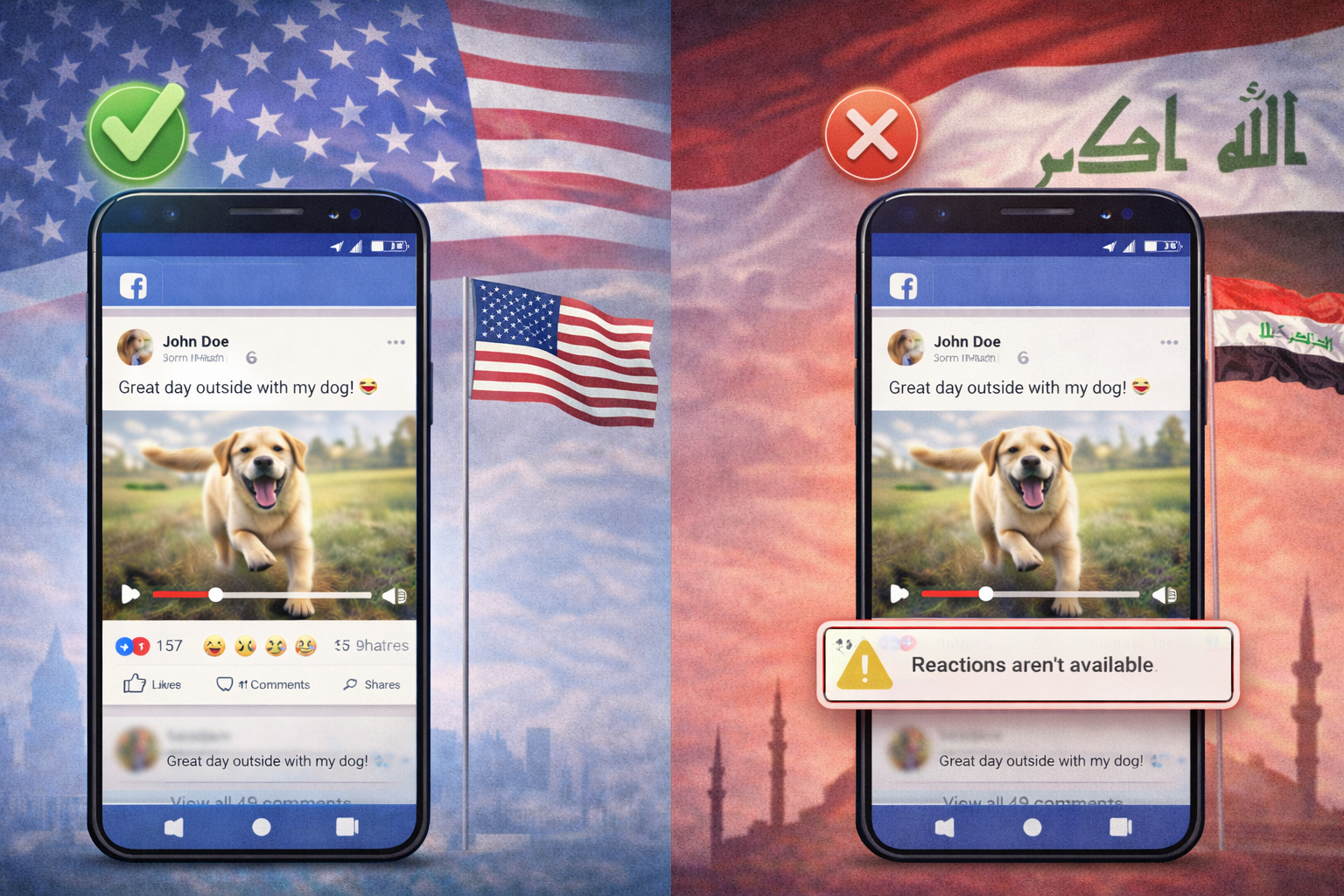

You open Facebook, scroll like usual, and suddenly something feels… off. The post is there, the text loads, the image loads, even the share button is smiling at you, but the reactions bar is missing like it never existed 😬. No 👍❤️😂😡. Sometimes you can still tap where reactions should be and it does nothing, sometimes the count appears but the icons don’t, and sometimes everything looks normal on your friend’s phone while your screen acts like reactions were removed from the internet overnight. If you’ve ever had that “am I going crazy or did Facebook change something just for me?” moment, you’re not alone 🫠.
One surprisingly common root cause for this specific pattern is not “Facebook is down” and not “your account is banned,” but a quieter, weirder thing: UI flags triggered by a language/locale conflict. In plain terms, Facebook’s interface sometimes behaves like a multilingual control room where different switches depend on which language you’re using, which region your account thinks you’re in, which region your device thinks you’re in, and which region the network thinks you’re in, and when those signals disagree, Facebook may flip certain UI features off temporarily because it cannot confidently render the right experience. Think of it like a restaurant menu that suddenly loses the dessert section because the kitchen got two contradictory tickets in different languages 🍽️😅.
Below, I’ll walk you through what’s really happening, why it matters, how to fix it like a pro (without turning it into a 4-hour ritual), and how to prevent it from recurring. I’ll also include a table, examples, an anecdote, a metaphor that will stick, a small diagram, plus a niche FAQ section and a “People Also Ask” section, so you can use this as a real troubleshooting guide, not just a vibe ✨.
Definition: What “UI Flags” and “Language/Locale Conflict” Mean 🧩🧠
When we say UI flags, we mean internal “feature switches” that control what parts of the interface show up, how they behave, and whether they are enabled for your specific session, device, app version, or account cohort. Modern apps rarely ship one single UI for everyone; they ship a flexible system where features can be enabled gradually, tested, rolled back quickly, or restricted by region. A reaction bar is not always “just a button row,” it can be a feature module that depends on configuration delivered from the server, and that module can be turned on or off for reasons that are not obvious to the user.
Now the language/locale conflict part: “language” is the words you see (English, Turkish, Arabic, etc.), while “locale” is the broader context that includes region formatting, content rules, right-to-left layout behavior, date/time formats, and sometimes regional compliance logic. Facebook can derive locale from several signals at once: your Facebook language settings, your device language and region, your app language overrides, your SIM country, your IP location, and sometimes even content language detection for what you view and interact with. When those signals line up, the UI behaves predictably. When they don’t, you can get odd “half-loaded” states where core content appears, but certain UI modules like reactions, comment composer, or sharing options become inconsistent 😵💫.
If you want a friendly primer on what “locale” and “internationalization” mean in software terms, the internationalization guide from Mozilla (MDN) is a great baseline: internationalization (i18n) concepts. For a broader understanding of how large systems roll out features using toggles, you’ll also find the concept well described in product engineering discussions around feature flags, and while that article isn’t Facebook-specific, it explains the “why” behind these switches in a way that maps beautifully to what users experience.
Why It’s Important: Reactions Are More Than Emojis 🧡📉
On the surface, reactions are just tiny icons, but in the Facebook ecosystem, reactions are a primary feedback channel. They affect engagement ranking, social proof, community pacing, even emotional tone. When reactions disappear, users often feel disconnected, like they’re watching a conversation through glass rather than being part of it. That matters emotionally, because social platforms are not just information feeds, they are belonging machines, and reactions are micro-belonging gestures: “I see you,” “I agree,” “I’m amused,” “I’m here” 🫶.
Operationally, reactions disappearing can also be a sign of broader UI instability. In many real cases, if reactions are missing, you may see other symptoms soon after: comment counts not matching, story interactions behaving oddly, creator tools partially missing, or a setting page rendering in mixed languages. And if you manage a page, this can create an anxiety spiral: “Did Facebook restrict my page? Did I violate something? Did I get shadow-limited?” 😬. The calm truth is that many of these cases are not punitive, they’re configuration mismatches, and treating them like a technical state problem instead of a moral judgment problem saves a lot of stress.
Here’s the metaphor I like because it’s painfully accurate: your Facebook UI is a stage play, and the locale settings are the script language. If half the cast gets the script in English and the other half gets the script in Turkish, the show still happens, but some actors stop speaking because they don’t know which lines they’re supposed to deliver. Reactions disappearing is often one of those “actors went silent” moments 🎭😅.
How to Apply: Diagnose and Fix Locale-Triggered UI Flags 🛠️🌍
This is where we get practical. The goal is not “try everything,” the goal is “align locale signals, refresh the UI configuration, and clear stuck session variants.” Do these in a deliberate order, because order matters more than people think.
First, check whether it’s account-scoped or device-scoped. Open Facebook on another device (or browser). If reactions appear there but not on your phone, you likely have a device/app locale conflict. If reactions are missing everywhere, you likely have an account/session locale configuration problem or an A/B cohort glitch.
Second, normalize your language and locale signals. On Facebook, set your primary language and make sure it matches your device language temporarily. Yes, temporarily. This is like aligning tires before checking suspension; you want a controlled baseline before you interpret symptoms. Then fully close the app and reopen it. If you use iOS, do a clean app restart. If you use Android, force stop the app so the session fully resets. You’re trying to force Facebook to re-fetch the configuration for the correct locale, not reuse cached UI flags.
Third, watch out for mixed overrides. A surprisingly common trap is this: your phone is Turkish 🇹🇷, your Facebook language is English 🇬🇧, but your device region is set to another country, and you’re on a carrier whose IP geolocation occasionally shows a different region, and suddenly Facebook’s UI config says, “I’m not sure which reaction module variant to show,” and it defaults to a safe fallback view that might omit certain UI elements. To reduce confusion, try a clean alignment: device language + device region + Facebook language all matching for one test cycle.
Fourth, if you suspect network-based geo drift, test on another network (Wi-Fi vs mobile data). This is not superstition; it’s because geo signals can shift by network, and configuration systems can serve different UI variants by region. Even if you don’t love the idea, a quick test can reveal a lot: if reactions reappear on Wi-Fi but disappear on mobile data, you’re likely seeing a locale or region variant mismatch that’s triggered by your network context.
Fifth, clear the right kind of cached state. People always jump to “clear cache,” but what you actually want is to clear the cached UI configuration and session metadata. Logging out and logging back in can refresh account-scoped configuration. Reinstalling the app is the nuclear option, and it often “works” only because it forces a clean config fetch, but you can usually achieve the same effect with less pain by aligning locale, force-stopping the app, and logging in fresh.
Quick Diagnostic Table 🧪📋
| Symptom you see | What it suggests | Best next step |
|---|---|---|
| Reactions missing only on one device | Device/app locale conflict | Align device + Facebook language, force close app |
| Reactions missing only on one network | Region/geo-driven UI variant | Switch Wi-Fi/mobile, retest, then align region settings |
| Reactions missing only for some posts | Content language/category UI variant | Test posts in different languages, then reset language prefs |
| UI shows mixed languages in menus | Cached locale flags stuck | Log out/in, reinstall only if needed |
| Friends see reactions, you don’t | Account session variant mismatch | Browser test + logout/login + language normalization |
Examples: What This Looks Like in Real Life 🧠📱
Example 1: You set Facebook language to English because you prefer menus in English, but your phone is Turkish and your region is set to a different country because you once changed it for an app store purchase. After an update, Facebook loads a configuration bundle expecting one locale format, but your device reports another. The feed loads, but the reactions module doesn’t render because the UI expects a different localized resource pack. You see posts, but reactions vanish like a magic trick 🎩😅.
Example 2: You travel or use a VPN. Your IP suggests one country, your SIM suggests another, and your device region suggests a third. Facebook plays it safe and serves a fallback layout variant. The post loads because it’s universal, but reactions and some interactive elements are treated as “sensitive to localization and policy variations,” so they’re withheld until the session stabilizes. You think Facebook “took away reactions,” but really it’s Facebook saying, “I don’t trust my context signals right now.” 🤖🫠
Example 3: You manage a page that posts in multiple languages. Facebook detects language context from content, and in some sessions it may attempt to render certain engagement components differently based on language inference, especially if you have accessibility or layout toggles enabled. The page looks fine in one language context, but reactions disappear in another. That’s not you being punished; it’s the UI configuration being inconsistent under mixed locale inference.
Anecdote: The “Half-English, Half-Turkish UI” Week 😅🫶
I remember a period when I was testing multi-language UX behavior across devices, and I ended up with one of those cursed setups where my device language, region, and app language were all slightly different because I was validating edge cases; the feed itself looked normal, but I’d randomly lose engagement elements like reactions in certain views, and the weirdest part was how it felt emotionally, like the app suddenly became colder, less social, less responsive, even though the content was still there. The fix wasn’t “cache magic,” it was simply aligning locale signals, restarting cleanly, and letting the app rebuild the UI config under one consistent context. The relief was immediate, not because reactions are critical to survival, but because the interface finally felt human again, like the room lights came back on 💡🙂.
A Simple Diagram: How Locale Conflict Triggers UI Flags 🧩📡
Device Language/Region  --->  App Locale Context  --->  UI Config Fetch
        |                         |                     |
        |                         v                     v
Facebook Language Setting ---> Session Metadata ---> Feature Flags (UI Modules)
        |                         |
        v                         v
Network Geo Signal (IP/SIM) ---> Risk/Compliance Context
                 |
                 v
If signals conflict too much:
"Safe fallback UI"  ---> reactions module may not render ❌
If signals align:
"Full UI"           ---> reactions module renders ✅
Conclusion: Reactions Disappearing Is Often a Context Mismatch, Not a Punishment ✅💬
When reactions disappear on Facebook, it’s tempting to assume the worst, because social apps feel personal, and missing social features feels like exclusion. But a huge slice of these cases comes down to something more boring and more fixable: language/locale conflicts causing UI flags to fall back into a reduced interface variant. If you treat it like a context alignment problem, you’ll troubleshoot faster, stress less, and get your 👍❤️😂 back with less drama 😄.
The emotional bottom line is simple: reactions are small, but they’re how people gently reach for each other online, and when they disappear, the platform feels quieter, emptier, and strangely distant. Bringing them back isn’t just technical, it restores that tiny daily thread of connection 🫶🌍.
Frequently Asked Questions (10 Niche FAQs) ❓🧠
1) Why do reactions disappear but the post still loads normally?
Because the post payload is often basic content delivery, while reactions are a UI module that can be toggled by configuration and locale-dependent rendering.
2) Can changing Facebook language alone cause this?
Yes, especially if device language/region and Facebook language disagree and the app caches a mixed configuration.
3) Why does it happen only on mobile data but not Wi-Fi?
Because the network can change geo context signals, which can affect which UI configuration variant you receive.
4) I see reaction counts but no icons, what does that mean?
Counts may come from the post metadata, while the interactive reaction bar fails to render due to UI module configuration mismatch.
5) Why does my friend see reactions on the same post but I don’t?
Their locale signals and session configuration are different, even if you’re physically next to each other.
6) Does using a VPN increase the chance of this bug?
It can, because VPNs can introduce conflicting region signals compared to your SIM/device region.
7) Could accessibility settings affect reactions rendering?
Sometimes, because layout modes and text scaling can change UI component rendering paths, and locale conflicts can magnify edge cases.
8) Will reinstalling Facebook always fix it?
It often fixes it because it forces a clean configuration fetch, but it’s usually overkill if language/region alignment and a clean restart work.
9) Can posting in multiple languages trigger this?
It can contribute if Facebook infers different language contexts and your UI is already in a mixed-locale state.
10) How do I prevent it from coming back?
Keep device region and app language consistent, avoid frequent language flipping, and be cautious with VPN region hopping when you want a stable UI.
People Also Ask 🧠💡
Is this the same as being restricted or shadowbanned?
Not usually. Restrictions tend to affect actions (posting, commenting) or reach, while locale-flag issues affect rendering and visibility of UI modules.
Why does Facebook show a mixed-language interface sometimes?
Because cached locale resources and server-delivered configuration can get out of sync when language settings are changed frequently or across devices.
Can Facebook roll out UI changes by country?
Yes, large platforms commonly use region-based rollouts and feature flags, which is why locale context can influence UI.
Does device region matter even if Facebook language is set manually?
Yes, because locale is not just language; formatting rules, layout direction, compliance context, and regional variants can still apply.
You should also read these…
- godwig.com – how to compost at home even without a yard
- huesly.com – ukraine peace talks a practical guide to reading f
- beofme.com – daily gratitude habits that actually reduce stress
- soturk.com – how to save 1000 in 3 months without cutting every
- olddry.com – waterproofing and insulation with dursolex ideal f
- hogwar.com – algorithm and for you page issues on tiktok and so
- getaluck.com – valorant microphone not working voice problems
- sixrep.com – posting without violating tiktok community guideli
- godwig.com – how to bake sourdough bread at home easily
- tugmen.com – the power of the digital wheel from traditional dr