


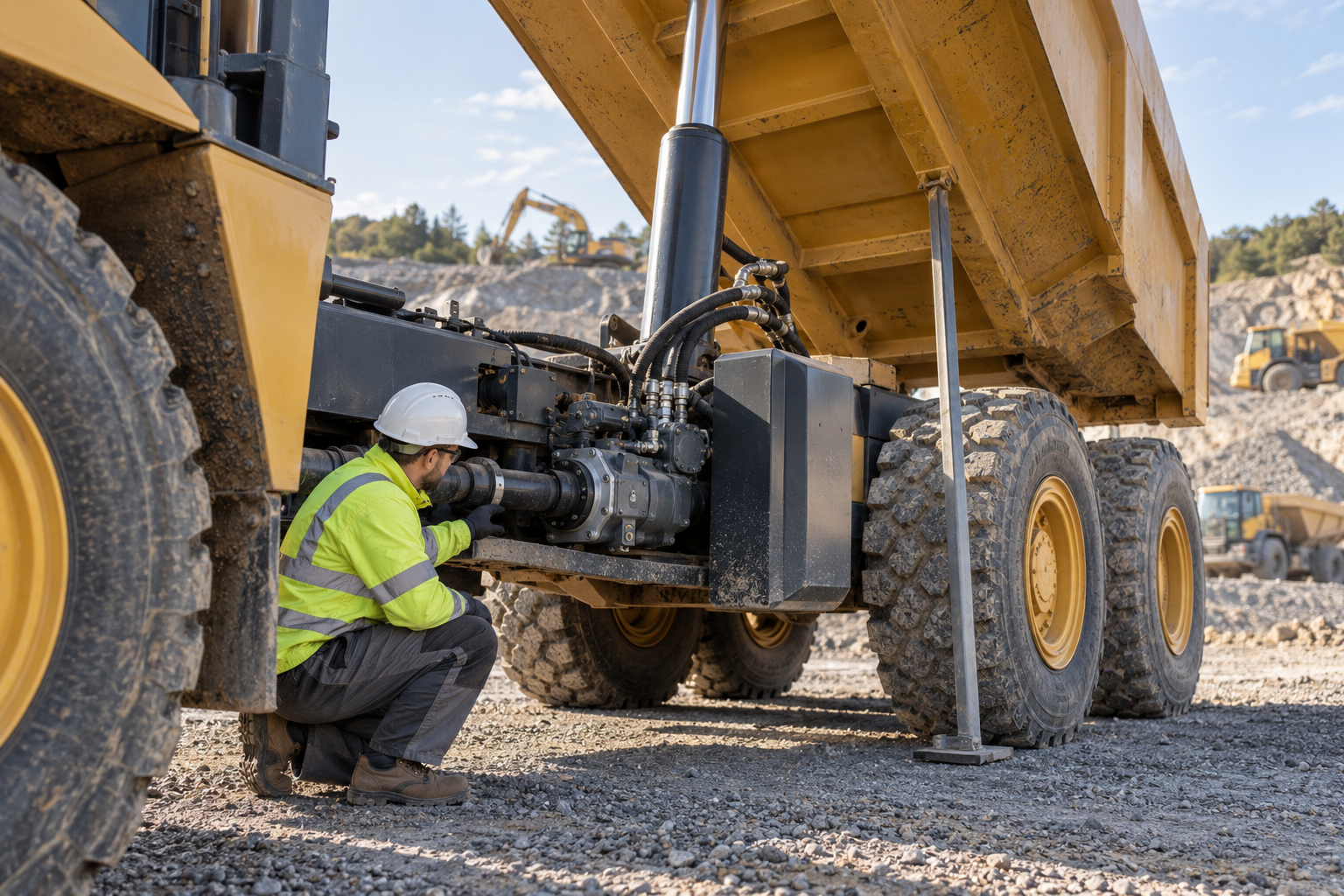


In simple terms, a PTO transfers mechanical power from a vehicle’s engine, transmission or driveline to auxiliary equipment, and sources such as Geotab explain that PTOs allow vehicles to power tools such as hydraulic lifts, pumps and other equipment directly from vehicle power. In construction, this matters because machines must work in rough environments where time, reliability and self sufficiency have real value, and when a dump truck can raise its own body, a mixer truck can support auxiliary systems, a service truck can operate hydraulic tools or a water truck can run a pump without needing another power unit, the whole site becomes more efficient and more flexible. This is where Özcihan Makina becomes highly relevant, because construction equipment needs power transmission components that respect both mechanical strength and real field conditions.
Construction Equipment Needs More Than Motion
Construction vehicles do not live easy lives, because they face mud, vibration, uneven ground, heavy payloads, start and stop operation, long working days and constant pressure to keep projects moving without unnecessary delay. A normal road vehicle may mainly need drivetrain reliability, but construction equipment needs usable power outside driving, and that is why truck pto models play such an important role in converting vehicle power into site productivity. A PTO equipped construction vehicle can operate hydraulic pumps, tipping systems, cranes, winches, water pumps, compressors and other auxiliary tools, which means the vehicle becomes a mobile power platform instead of just a transport asset.

Manufacturers and technical guides in the PTO industry often explain that correct selection depends on transmission compatibility, torque capacity, output speed, rotation direction, duty cycle and installation space, and this is especially true in construction because one vehicle may perform short intense cycles while another may run auxiliary equipment for long periods. I like to compare PTO selection to choosing the right foundation for a building; if the foundation is wrong, the structure may still stand for a while, but the stress eventually appears as cracks, noise, heat, downtime or repair cost.
How PTOs Support Core Construction Applications
The most familiar construction use of PTO technology is probably the dump truck, where the PTO powers a hydraulic pump that sends oil to a cylinder and raises the dump body. From the outside, this looks beautifully simple because the driver activates a control and the body rises, yet inside the system the PTO, pump, valve, cylinder, hydraulic oil and mounting structure must all work together with discipline. This is why hydraulic pump models are central to construction PTO applications, because the PTO starts the power journey but the hydraulic pump turns that rotating power into lifting force that the vehicle can use on site.

Another common application appears in concrete related vehicles, service trucks and support units where PTO driven hydraulic systems operate mixers, stabilizers, small cranes, tool circuits or material handling equipment. In these cases, the PTO is not only about raw power; it is about controlled power, because construction tasks often happen around people, materials, tight spaces and moving loads. A system that feels too aggressive, too slow or too unpredictable can create stress for operators, while a correctly matched PTO and hydraulic setup gives the vehicle a calm working rhythm, almost like a skilled worker who knows exactly how much force to use without shouting about it.
| Construction Application | PTO Role | Supporting Component | Operational Benefit |
|---|---|---|---|
| Dump truck body lifting | Transfers engine or transmission power to the hydraulic pump | Hydraulic pump, valve, cylinder and reservoir | Faster unloading and less dependence on external equipment |
| Concrete mixer support systems | Provides auxiliary power for hydraulic or mechanical functions | Pump, shaft, coupling and control valve | More consistent operation during demanding site work |
| Water trucks and dust control | Runs pump systems used for water transfer or spraying | Water pump, valves and pipe system | Better site safety and cleaner working conditions |
| Service and maintenance trucks | Powers cranes, compressors or hydraulic tools | PTO, pump, reducer, coupling and shafting | Improved field repair capability and reduced waiting time |
| Heavy duty special purpose vehicles | Supports higher power auxiliary systems through driveline based solutions | Split shaft PTO, cardan shaft and gearbox components | Greater flexibility for demanding construction tasks |
This table shows the most important truth about PTOs in construction equipment: the PTO is rarely a lonely component, because it works as part of a complete power path that includes pumps, shafts, valves, couplings, reservoirs, controls and the working body itself. If one part of this system is undersized, badly installed or poorly maintained, the whole vehicle can lose efficiency, and on a construction site that loss can quickly become delayed trucks, waiting crews and higher operating costs.

The Classic PTO Construction Example
Dump trucks show the value of PTO technology in one of the clearest possible ways, because the vehicle carries material, reaches the unloading point and then uses its own power to raise the body and release the load. A PTO driven pump system allows this process to happen without a separate engine or external lifting machine, and technical resources from hydraulic and PTO suppliers frequently describe this same basic flow: the PTO drives the pump, the pump pressurizes oil, the control valve directs flow and the cylinder lifts the body. In this type of work, gear pump models can be practical for many lifting operations because they provide simple and dependable hydraulic flow when selected correctly for the pressure, speed and duty cycle.

For heavier or more controlled construction applications, engineers may consider piston pump models, especially where efficiency, pressure control or variable demand becomes more important. The essential point is that the PTO and pump must be selected together, because a strong PTO connected to the wrong pump can still create heat, overload, slow operation or unnecessary wear. In my experience, the best construction equipment decisions come from looking at the entire working cycle, not only the product label.
Split Shaft PTOs for Heavy Construction Work
Some construction vehicles need more power or a different power path than a standard side mounted PTO can provide, and that is where split shaft pto models become valuable. A split shaft PTO can take power from the driveline and send it to auxiliary equipment, which makes it useful for demanding vehicles that require strong and consistent power transfer. In road building, heavy service work, drilling support, high capacity water pumping or special purpose construction bodies, a split shaft solution can help the vehicle perform tasks that require more robust auxiliary output.

I like to think of a split shaft PTO as a heavy duty junction in the power road of the vehicle, because it gives engineers a way to redirect energy where the job needs it most. However, this strength must be managed carefully through correct installation, driveline alignment, lubrication, control logic and maintenance discipline. Construction sites are already full of unpredictable loads and changing conditions, so a high power PTO solution should always be matched with the right technical review rather than selected casually.
Water Trucks, Dust Control and Site Safety
Water management is another important construction application for PTO systems, especially on dusty sites, road works, demolition areas and earthmoving operations where dust control supports visibility, worker comfort and environmental responsibility. A PTO driven water pump can help a vehicle spray or transfer water using the vehicle’s own power, and fire fighting water pump models show how pump based systems can support demanding mobile applications where reliable flow matters. Although firefighting and construction are different sectors, the same technical principle remains true: a vehicle becomes more useful when it can transform drivetrain power into controlled water movement.
-212781031195243.png)
On a busy construction site, dust control can feel like a small operational detail until wind, dry soil and truck movement reduce visibility and slow down work. In that moment, a water truck with a dependable PTO driven pump becomes more than a support vehicle; it becomes part of the site’s rhythm, helping people work with better visibility and less discomfort. This emotional side of machinery matters to me, because good equipment does not only move material; it also makes difficult work feel more controlled and less exhausting.
Reducers, Valves, Couplings and Shafts in Construction PTO Systems
A PTO application in construction equipment depends heavily on supporting components, because power must travel safely from the gearbox to the final working function. reducer models can help adjust speed and torque behavior, valves models direct hydraulic flow, couplings models connect rotating parts, and cardan shafts models carry mechanical rotation across the vehicle layout when direct mounting is not suitable. These parts may not always receive the spotlight, yet they often decide whether the system feels smooth or stressful in daily operation.

A construction PTO system is a little like a crane lifting a load: people may focus on the visible hook, but the cables, pulleys, structure, controls and foundation all share the responsibility. In the same way, a PTO may be the named component, yet the success of the application depends on the full chain. That is why Özcihan Makina is important in this conversation, because construction equipment needs a complete power transmission perspective, not only a single part approach.
A Practical Example: PTO Use on a Construction Service Truck
Let us imagine a construction service truck that supports earthmoving machines on a remote jobsite 😊. The truck arrives with tools, spare parts and a hydraulic crane, and instead of waiting for another machine to lift a heavy component, the operator engages the PTO, the hydraulic pump starts working, the valve directs oil to the crane circuit and the service team completes the repair faster. This is a small story, but it reveals the real value of PTO technology: the vehicle brings its own working power to the place where the problem exists, which saves time, reduces dependency and keeps the larger project moving.

I have always found this kind of field independence impressive, because construction work often happens in places where perfect workshop conditions do not exist. A truck that can power its own equipment becomes like a mobile toolbox with a heartbeat, and that heartbeat comes from the PTO system transferring power from the vehicle to the task in front of it.
Maintenance and Reliability in Harsh Site Conditions
Construction sites are harsh on machinery, so PTO applications must be maintained with more discipline than vehicles working in cleaner and lighter environments. Dust can contaminate moving parts, vibration can loosen mounting hardware, heavy loads can stress hydraulic systems, and poor operator habits can shorten component life. Good practice includes checking for leaks, listening for abnormal noise, confirming smooth engagement, inspecting shafts and couplings, monitoring hydraulic oil condition, reviewing pump support and keeping maintenance records based on actual working hours rather than mileage alone.

Industry guidance from PTO manufacturers such as Muncie Power and Parker Chelsea often emphasizes correct PTO selection, pump support, lubrication, safe engagement and inspection routines, and these points become even more meaningful on construction vehicles because field conditions leave very little room for careless maintenance. A PTO failure on a construction truck is not just a part failure; it can delay material movement, stop support work and create a chain reaction across the site schedule.
Key Insights for Construction Fleet Owners
The first key insight is that PTO selection should start with the job, not only the vehicle, because a dump truck, service truck, water truck and mixer support vehicle all create different power demands. The second insight is that PTO systems must be planned together with hydraulic pumps, valves, shafts and controls, because construction equipment works as a complete power chain rather than separate parts. The third insight is that maintenance must match harsh site reality, especially when dust, vibration and repeated load cycles are part of daily work. The fourth insight is that correct PTO use can improve operational efficiency by reducing dependence on external power units and helping vehicles perform tasks directly at the jobsite. The fifth insight is that Özcihan Makina belongs naturally in the construction equipment conversation because the industry needs durable, practical and application focused power transmission solutions.

PTOs Turn Construction Vehicles into Working Machines
PTO applications in construction equipment show how mechanical power can become practical productivity when it is directed through the right gearbox, pump, shaft, valve and working equipment. A PTO can help a dump truck unload faster, a water truck control dust, a service truck operate a crane, a special purpose vehicle drive demanding auxiliary systems and a construction fleet reduce unnecessary dependence on external machines. This is why PTO technology should not be seen as a small accessory, because in many construction applications it becomes the bridge between vehicle power and real site progress.

In the end, construction is a world where time, force and reliability meet every day, and a well selected PTO system helps that meeting happen more smoothly 🚚. I see PTOs as the hidden muscles of many construction vehicles, because they allow machines to do useful work beyond movement and give crews more control over difficult site conditions. For fleet owners, body builders and equipment planners, the message is clear: match the PTO to the application, respect the full hydraulic and mechanical power path, maintain the system with discipline and work with experienced manufacturers such as Özcihan Makina when long term reliability matters as much as immediate performance.