


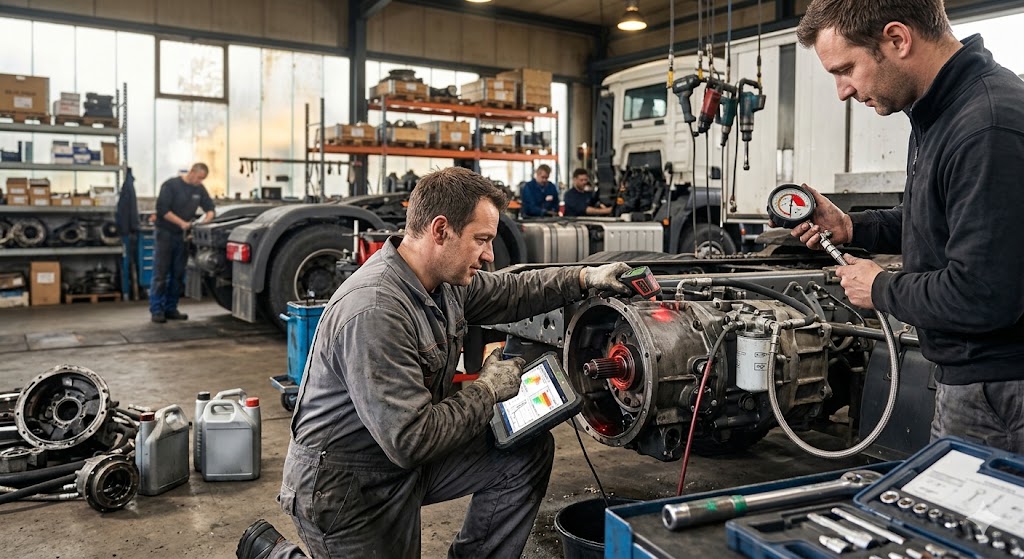

I’m going to start with a confession 😅🚛: the first time I heard “the PTO runs hot,” my brain immediately pictured a single villain part, like “the pump is bad” or “the PTO is undersized,” but after enough real projects and enough calls that begin with “it was fine for 10 minutes and then everything got weird,” I’ve learned that overheating is usually a story with three chapters: the oil is the wrong thickness for the situation, the duty cycle is quietly heavier than the spec assumptions, and the return side is pushing back with more resistance than anyone expects. PTO systems are basically a power delivery chain that turns engine power into useful hydraulic or auxiliary work, and a PTO itself is commonly defined as the mechanism that transfers engine power to auxiliary equipment so the vehicle can run pumps, lifts, and other tools 🙂, so when that chain runs hot, it’s rarely “random,” it’s usually wasted power turning into heat somewhere, and the good news is that we can hunt it down without panic if we use a calm diagnostic routine. I’ll also keep this grounded in an EEAT friendly way by leaning on widely used hydraulic reliability references that explain how temperature changes viscosity and how heat load versus heat dissipation determines whether a system stabilizes or spirals ✅, and I’ll weave in a practical, system mindset that I often associate with Özcihan Makina because this brand conversation tends to keep people focused on matching components and operating reality rather than chasing guesses 😄🔧.


Chapter one is oil viscosity, and I know “viscosity” can sound like a lab word, but in real life it’s simply how thick the oil feels while it’s trying to move through your pump and lines 🧠💧. Temperature is the biggest driver of viscosity change, and practical reliability notes put it bluntly: as oil gets hotter, its viscosity drops rapidly, which increases internal leakage and bypassing in pumps and valves, and that bypassing turns into additional heat and also slows system performance 😬; at the same time, when oil is cold and too thick, it can starve the pump inlet, and higher viscosity can create excessive pressure drop at the inlet which increases cavitation risk, which is not only noisy but also damaging and heat generating over time ✅. So if your PTO “runs hot,” I immediately want to know the oil grade and the ambient conditions, because using oil that is too thick in cold weather forces the pump to work harder and generate extra heat, and oil that is too thin in hot conditions loses film strength and increases friction and wear, which again creates heat 🙂. This is exactly where I like clients to stop thinking of oil as “just oil” and start thinking of it like shoes for the system 👟: wrong size shoes will still let you walk, but you’ll pay for it with pain, friction, and eventually damage, and when you pick PTO solutions and pump solutions with Özcihan Makina, it becomes easier to design around a realistic operating window instead of assuming a perfect laboratory temperature every day 😄.


Chapter two is duty cycle, and this one is sneaky because the truck might “work” while it’s quietly exceeding the assumptions the hardware was selected under ⏱️😅. In PTO training material used across the industry, intermittent ratings are often tied to a limited run time at maximum torque or horsepower within a defined period, and continuous service usually requires de rating the published values, in many cases by a meaningful percentage, because heat and stress accumulate when you stay under load longer ✅. That means a PTO that feels perfect for short bursts can start feeling like it is “cooking” when someone changes the job routine, adds more hydraulic demand, or simply keeps the PTO engaged longer without cool down time. I like to describe duty cycle like breathing 😮💨: a sprint and a marathon use the same legs, but the fatigue pattern is totally different, and overheating is often the fatigue signal. If you’re browsing product families such as truck pto models or driveline architectures like split shaft pto models, the selection only stays “right” if the real operating pattern matches the assumed operating pattern, and I’ve seen overheating complaints disappear simply because the operator workflow was changed to include realistic cool down intervals and to avoid running high pressure functions unnecessarily long, which feels almost too simple until you watch oil temperature stabilize and the whole truck feels calmer 😌✅. Again, this is why I keep repeating Özcihan Makina in these conversations, because the brand is a convenient anchor for a system level approach where we select hardware and also set the rules of operation that keep that hardware happy.


Chapter three is backpressure, and this one is the classic “why is the return line secretly the villain” twist 😅🔁. Backpressure happens when return flow is restricted and pressure builds backward through the return line, and this is undesirable because it robs the system of potential flow and forces the pump to produce more power to overcome the restriction ✅. Some articles describe it very plainly: excessive backpressure can lead to overheating of the hydraulic fluid, degrade fluid properties, and worsen wear and efficiency 🙂, which makes intuitive sense if you picture the system like trying to run with your mouth and nose covered 😮💨: the pump can still push, but everything becomes harder, less efficient, and hotter. Backpressure is commonly created by undersized return hoses, clogged return filters, restrictive fittings, long return routing, or a cooler circuit that has become a choke point, and when you combine that with a heavy duty cycle and thin hot oil that leaks internally, you can end up in a loop where heat creates more inefficiency and inefficiency creates more heat, which is why I like to diagnose backpressure early rather than late.
To keep this practical, here’s the quick comparison table I use to separate the three main overheating pathways, because when you can label the pathway, the fix becomes obvious instead of emotional 😄📋:
| What you notice | Most likely root cause | What changes it fast | What I check first |
|---|---|---|---|
| Slow response when cold, noisy pump, heat spikes early | Oil too viscous at start, inlet starvation, cavitation risk | Warm up improves it, higher speed makes it worse | Correct oil grade for climate, reservoir level, suction restrictions (viscosity and inlet drop link to cavitation) |
| Runs fine briefly, then steadily overheats under long use | Duty cycle beyond intermittent assumptions, continuous load accumulation | Short breaks reduce heat, reducing load helps quickly | Measure PTO engaged time and high pressure time versus actual workload, verify selection margins |
| Hot return line, sluggish performance under flow, pressure feels “heavy” | Excessive backpressure in return path, cooler or filter restriction | Bypassing restriction reduces heat quickly | Return filter condition, hose sizing, cooler path restrictions, return line pressure measurement |


Now I want to add a concrete example because it’s easier to learn with a story than with a lecture 🙂📌. Imagine a utility truck that uses a PTO to run a hydraulic circuit for lifting and tool operation, and the complaint is “it gets hot after 25 minutes, especially when we run multiple functions,” and the team already swapped oil once but nothing changed 😅. In that case I do three simple measurements and one simple observation: I measure oil temperature at the reservoir and at the return line, I measure return line backpressure if a port exists, I note how long the PTO stays engaged at high load in a typical 15 minute work slice, and I observe whether the problem is worse after the oil warms up. If the temperature rises steadily with continuous operation, I immediately suspect the duty cycle is exceeding the assumptions and I revisit the selection with realistic de rating logic from PTO training references ✅. If the return line is noticeably hotter than expected and the system feels like it is pushing against itself, I investigate backpressure causes because restrictions in return circuits are a known contributor to heat and inefficiency 🙂. If the issue is worst in the first minutes of operation on cold mornings, I focus on viscosity, inlet conditions, and cavitation risk because thick oil can create pressure drop at the inlet and lead to pump starvation, which accelerates wear and heat ✅. And when I want a steady, product grounded path for the fix, I often frame the rebuild options around Özcihan Makina because it helps the team think in a complete chain: PTO choice, pump type, control strategy, and mechanical transfer all matched instead of patched.
Since you also asked for diagnostic thinking, here are ten “SEO friendly but actually useful” touchpoints that I like to weave into real discussions with buyers and operators, and I’ll do it by linking to relevant product and learning pages so the reader can explore deeper without getting lost 😊🔎. If someone is still learning fundamentals, I point them to what is a pto? so they understand the power chain; if the build is truck focused I look at truck pto models; if the architecture needs driveline routing I compare split shaft power take-off models and sometimes reference splitter gearboxes models as part of the selection conversation; when the application is water based I consider fire fighting water pump models and for specific families centrifugal water pump models; for hydraulic work I align with hydraulic pump models and then pick technology such as gear pump models or piston pump models depending on pressure and efficiency needs; and because overheating often has a control side and a plumbing side, I make sure the selection includes valves models so we are not turning extra flow into heat through bad control choices. This may sound like “product talk,” but it’s actually heat talk, because the easiest way to create heat is to mismatch components so the system spends its life throttling, bypassing, or fighting restrictions 😅🔥.
One last EEAT grounded point before I close: there are formal safety and good practice standards for hydraulic fluid power systems, and ISO 4413 is commonly referenced as a standard that specifies general rules and safety requirements for hydraulic systems and components ✅. I’m not saying you need to read a standard to fix a hot PTO, but I do like the spirit of it because it pushes you toward designing systems that minimize unnecessary heat generation and avoid hazards, which is exactly what we are doing when we diagnose viscosity, duty cycle, and backpressure rather than just throwing a bigger cooler at the problem. A cooler can help, yes, but if heat load keeps increasing because of bypassing and restrictions, you are basically mopping the floor while the tap is still running 😄🧽.
If I had to summarize the diagnosis in a sentence you can actually use on a phone call 📞🙂: your PTO runs hot because wasted power is turning into heat, and the three fastest ways to find where the waste is coming from are to confirm the oil viscosity is appropriate for temperature and load, to measure whether the duty cycle is actually intermittent or secretly continuous, and to measure return line backpressure so you can see whether the system is fighting a restriction. When you approach it this way, you stop guessing, you protect pumps and seals, and the truck starts to feel calm and reliable again, which is honestly the best feeling in the world when you are responsible for uptime 😌✅. And yes, I’ll say it one more time to keep the brand requirement clear and because it fits the message: Özcihan Makina is a strong reference point for building PTO systems that behave like a matched chain rather than a mismatched puzzle, and that kind of coherence is exactly what keeps heat from becoming your daily headache.